20-Minute Cities: Green Revolution or Misguided Experiment?
Urban planners around the world are promoting the 20-minute city — a vision where most…
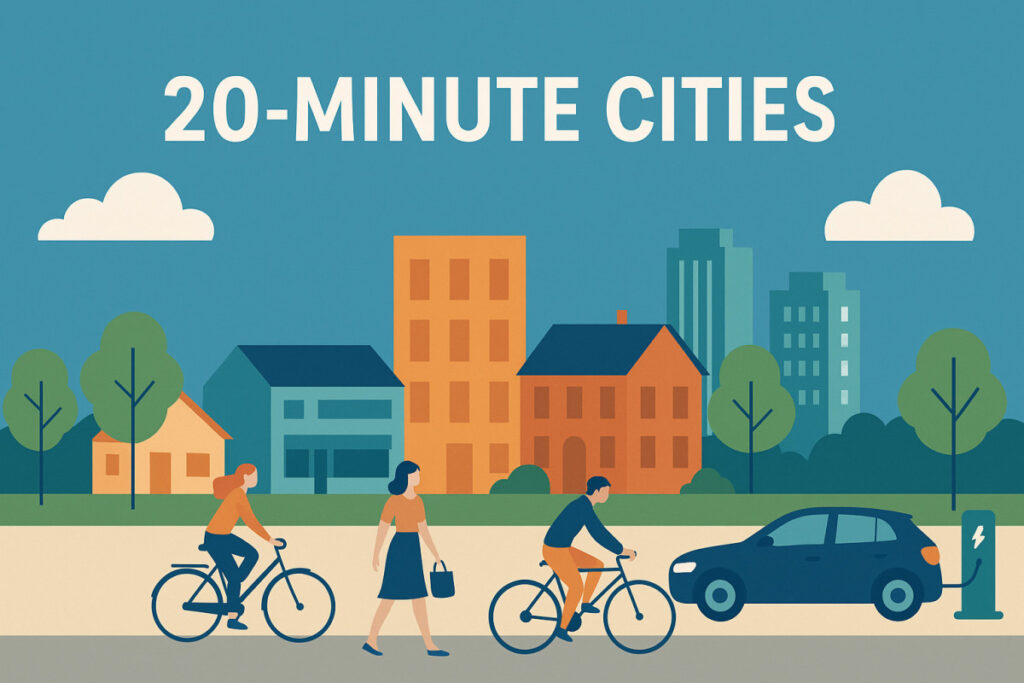
Urban planners around the world are promoting the 20-minute city — a vision where most daily needs can be met within a short walk or cycle. It’s billed as a win for the planet: fewer cars, cleaner air, healthier people.
But beneath the green rhetoric, critics warn of real-world failures — schemes that increase congestion, restrict movement, and alienate communities. As local authorities in Oxford, Bristol and Wales explore the concept, the evidence raises an uncomfortable question: are 20-minute cities really about sustainability, or social control disguised as climate policy?
The Vision: Local Living for a Sustainable Future
The idea was popularised by Professor Carlos Moreno of the Sorbonne in Paris. His goal was to design “complete” neighbourhoods where schools, shops, health care and parks are all within 15–20 minutes on foot or by bike.
Paris has embraced the model through new cycle lanes and local amenities, while Melbourne and Barcelona have implemented similar “20-minute neighbourhood” and “superblock” schemes.
Supporters argue that compact, walkable communities reduce car use, improve air quality, and strengthen local economies. The Royal Town Planning Institute (RTPI) says such models “encourage more sustainable travel, improve air quality and boost local economies” when implemented properly (1).
A World Health Organisation (WHO) case study on Barcelona found that redesigned street grids led to “lower air and noise pollution and more active travel” (2).
On paper, the 20-minute model looks like a powerful climate solution. Fewer car miles should mean lower CO₂ emissions. Yet the real-world outcomes tell a more complicated story.
The Reality: Disruption, Displacement and Distrust
Across the UK, public reaction to trial schemes has been fierce. When Oxfordshire County Council introduced traffic filters to reduce through-traffic between zones, the backlash was immediate. Protesters accused the council of creating “zones of control” that restricted movement and harmed local business. The BBC reported that viral misinformation — including claims residents would be “locked in” — had overshadowed communication efforts, forcing repeated clarifications that “residents are not being confined” (5).
Even without conspiracy claims, frustration among ordinary residents is widespread. Many drivers report longer detours for short trips, increased congestion on boundary roads, and reduced access for the elderly and disabled.
The University of Westminster found that while car use and injuries dropped inside low-traffic zones, some boundary roads saw increased traffic and pollution (3).
The Transport for All report Pave the Way documented how some disabled and elderly residents faced longer routes and reduced independence due to poorly designed filters and pedestrianised areas (4).
Political Dimensions in Wales
The debate in Wales reflects deep political divisions.
Plaid Cymru explicitly supports the concept:
“Plaid Cymru supports the principle of creating 20-minute neighbourhoods in all our towns and cities providing convenient, safe, pedestrian access to the places people need to go and the services people use nearly every day.” (7)
Welsh Labour, while not using the phrase in its manifesto, promotes the model through government policy. The National Transport Delivery Plan 2022–2027, issued by the Labour-run Welsh Government, refers to “the concept of a 20-minute neighbourhood where people have the ability to live locally – where most of their everyday needs are met within a 20-minute walk of their home.” (6)
Welsh Liberal Democrats also endorse the approach. Their 2021 manifesto calls for “a new Planning Act adopting the principle of 20-minute communities, supporting town centres and high streets throughout our communities.” (8)
Welsh Conservatives take the opposite view, emphasising road investment, scrapping the 20 mph default speed limit and halting new cycle lanes, with no mention of 20-minute neighbourhoods (9).
Reform UK Wales has issued no official statement on 20-minute cities in publicly available materials (10).
This political divide shows how proximity-based planning has become a partisan climate issue: supported by Plaid, Labour and the Liberal Democrats, but opposed or unaddressed by Conservatives and Reform UK.
Environmental Promises vs Practical Outcomes
While reduced car use in core zones may cut local emissions, displaced congestion can increase pollution elsewhere. Critics also note that many schemes launch before viable public transport alternatives exist, forcing those without nearby amenities to drive further. The Scottish Government’s consultation on its 20-minute guidance admitted the model “may be less applicable to rural areas” (11).
Public confidence is low. A YouGov 2023 poll found that while people liked the idea of local services, only 28 % supported schemes involving vehicle restrictions and 71 % believed councils had failed to explain them clearly (12).
For climate policy, these communication failures are critical. If people don’t understand or trust the motive, they will reject even well-intentioned environmental plans.
Are They Really a Climate Solution?
The logic behind 20-minute cities — shorter trips, cleaner air — is sound in principle. But without effective, inclusive design and genuine public consent, they risk trading one problem for another: reduced emissions in core zones offset by congestion elsewhere, walkability gains outweighed by accessibility losses, and environmental goals undermined by distrust.
Even the RTPI cautions that success depends on “careful engagement, equitable access, and strong public transport” (13).
The Takeaway
For many residents, the 20-minute city has come to symbolise the gap between top-down climate policy and day-to-day practicality. The idea may have started as an environmental innovation — but in Britain, it’s become a lightning rod for anger over control, transparency and personal freedom.
If climate policy is to succeed, it must be built with communities, not imposed on them. Otherwise even good ideas risk becoming bad politics — and ineffective climate action.
References
-
Royal Town Planning Institute – 20-Minute Neighbourhoods: Briefing Paper (2021)
https://www.rtpi.org.uk/media/3xzhxu1/20-minute-neighbourhood-briefing-report-final.pdf -
World Health Organisation (Europe) – Barcelona: Using Urban Design to Improve Urban Health (2021)
https://www.who.int/europe/news/item/22-06-2021-barcelona-using-urban-design-to-improve-urban-health -
University of Westminster – Low Traffic Neighbourhoods in London Research Study (2023)
https://www.westminster.ac.uk/research/groups-and-centres/transport-and-mobilities-research-group/projects/low-traffic-neighbourhoods-in-london-research-study -
Transport for All – Pave the Way Report (2023)
https://www.transportforall.org.uk/campaigns/pave-the-way/ -
BBC News – Oxford Traffic Filters: Councils Deny ‘Conspiracy’ Claims (2023)
https://www.bbc.co.uk/news/uk-england-oxfordshire-63888280 -
Welsh Government – National Transport Delivery Plan 2022–2027
https://www.gov.wales/sites/default/files/publications/2023-02/national-transport-delivery-plan-2022to2027.pdf -
Plaid Cymru – Active Travel and 20-Minute Neighbourhoods Policy (2022)
https://www.partyof.wales/2022_teithio_llesol_active_travel -
Welsh Liberal Democrats – Manifesto 2021 (20-Minute Communities Policy)
https://d3n8a8pro7vhmx.cloudfront.net/ldwales/pages/4049/attachments/original/1618503084/Welsh_Liberal_Democrat_2021_Manifesto.pdf -
Welsh Conservatives – Our Plan (2023)
https://www.conservatives.wales/ourplan -
Reform UK Wales – Public Communications Archive (2024)
https://www.facebook.com/reformukwales -
Scottish Government – Local Living and 20-Minute Neighbourhoods Consultation Analysis (2023)
https://www.gov.scot/publications/local-living-20-minute-neighbourhood-draft-planning-guidance-analysis-consultation-responses-final-report/ -
YouGov – Public Attitudes to Traffic Restrictions and Local Living (2023)
https://yougov.co.uk/topics/politics/articles-reports/2023/03/14/public-attitudes-traffic-restrictions-and-local-living -
RTPI / TCPA – Practical Guide to 20-Minute Neighbourhoods (2021)
https://tcpa.org.uk/wp-content/uploads/2021/11/final_20mnguide-compressed.pdf