BMW’s Hydrogen X5 Moves Closer To Production With 466-Mile Range Target
BMW’s hydrogen-powered X5 has taken another significant step towards production, with new prototypes now undergoing…
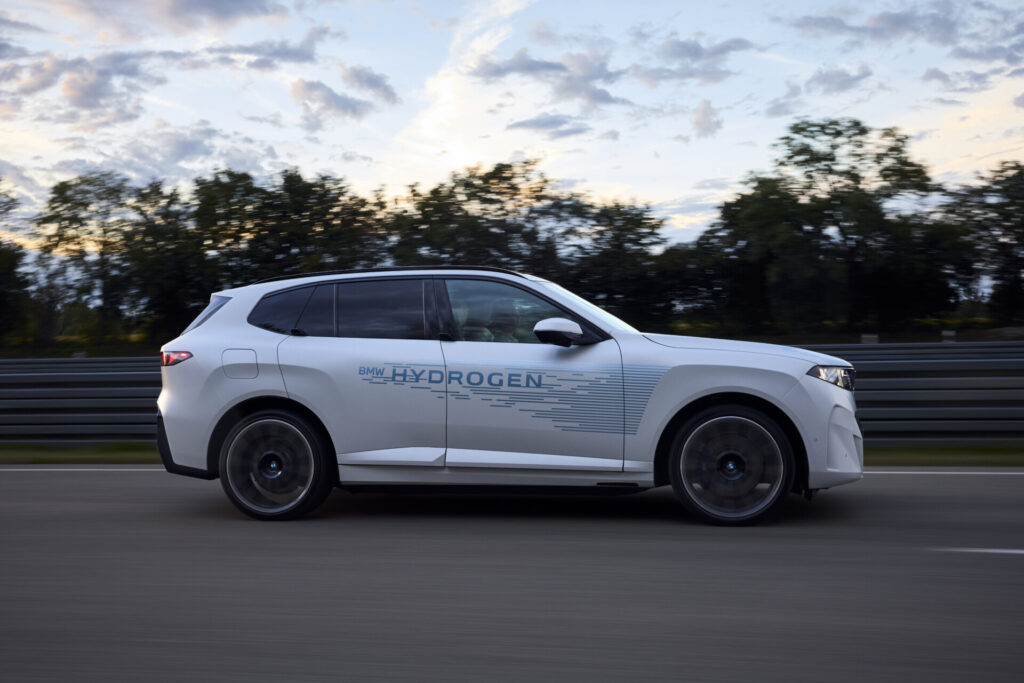
BMW’s hydrogen-powered X5 has taken another significant step towards production, with new prototypes now undergoing real-world testing as the manufacturer prepares to industrialise its next-generation fuel-cell technology.
The BMW iX5 Hydrogen is being put through an extensive testing programme designed to prove that hydrogen can deliver not only long-distance electric driving, but the performance and driving characteristics expected from a BMW.
The company is targeting a range of up to 750km – around 466 miles – on the WLTP cycle, while filling the hydrogen tanks should take less than five minutes.
BMW is also aiming for 0-62mph acceleration in under five seconds.
If those targets make it into the finished vehicle, the iX5 Hydrogen could address two of the issues that continue to concern some motorists considering battery-electric cars: lengthy charging stops and range on longer journeys.
There is, however, one major challenge that remains largely outside BMW’s control – drivers will need access to a viable hydrogen refuelling network.
Hydrogen X5 Put Through Real-World Tests
BMW says the current prototype programme is concentrating on how the complete hydrogen powertrain behaves in demanding environmental and operating conditions.
Engineers are testing the interaction between the fuel-cell system, electric motor, high-voltage battery, hydrogen storage system and the vehicle’s central control technology.
Rather than the hydrogen being burned in a conventional engine, it is used inside a fuel cell.
Hydrogen stored on board reacts electrochemically with oxygen taken from the surrounding air, producing electricity which can then power the electric motor.
The result is therefore still an electrically driven vehicle, but one which generates much of the electricity it needs from hydrogen rather than relying solely on energy stored in a large traction battery.
BMW’s third-generation fuel-cell system has been co-developed with Toyota.
Josef Hochreiter, head of Hydrogen Vehicles at the BMW Group, said: “Our ambition for the BMW iX5 Hydrogen is clear: a true BMW – with Sheer Driving Pleasure. A perfectly coordinated overall system is crucial for this. Current testing demonstrates how the fuel cell system, high-voltage battery and electric drive train are already successfully integrated and how systematically we are developing the technology towards series production.”
Up To 466 Miles And Refuelling In Under Five Minutes
For motorists, the potential range and refuelling time are arguably the most interesting aspects of the project.
BMW is targeting up to 750km – approximately 466 miles – between fills.
Hydrogen can then potentially be replenished in less than five minutes, giving the technology a refuelling experience much closer to petrol or diesel than conventional EV charging.
BMW’s latest hydrogen storage technology uses multiple 700-bar high-pressure tanks integrated into the vehicle.
The company’s new Hydrogen Flat Storage system has been designed to make better use of the space beneath the vehicle while avoiding a significant loss of passenger room.
The system can store at least seven kilograms of hydrogen.
Importantly, BMW stresses that the 750km figure is currently a development target rather than a final homologated range. Binding WLTP consumption figures are not yet available because the vehicle remains at the prototype stage.
Performance Still Matters
BMW is also making it clear that efficiency isn’t the only priority.
Engineers are targeting acceleration from 0 to 100km/h – 62mph – in less than five seconds.
The high-voltage battery plays an important role alongside the fuel cell, including capturing energy through regenerative braking and providing additional power when required.
The Energy Master – BMW’s central high-voltage system control unit – manages the interaction between components.
Engineers are currently refining that relationship to ensure the drivetrain can provide full performance under different operating conditions while also maximising efficiency.
Production Preparations Already Underway
BMW isn’t waiting until vehicle testing has finished before preparing its factories.
The next prototype assembly phase for the third-generation fuel-cell system is beginning at the company’s Hydrogen Competence Centre in Munich.
Previous work focused on whether individual components could be manufactured successfully and on qualifying suppliers.
The next phase is intended to refine manufacturing and testing methods so the technology can ultimately be produced reliably at much larger scale.
BMW Group Plant Steyr in Austria is being prepared for future series production of the fuel-cell systems.
Test benches and manufacturing equipment have already been installed, while employees are being trained in stages.
Additional system components will be manufactured at BMW’s Landshut facility.
Claudia Stephan, head of Technology Development and Fuel Cell Prototype Assembly at the BMW Group, said: “Prototype assembly is about much more than manufacturing individual components. Each phase helps us optimise processes, gain experience and systematically share this knowledge with the teams in Steyr. In this way, we are laying the foundation for the next steps on the road to industrialisation.”
One X5, Five Different Types Of Powertrain
Perhaps the most unusual aspect of BMW’s strategy is that the new X5 is being developed to accommodate a remarkably broad choice of powertrains.
Customers are ultimately expected to be offered petrol, diesel, plug-in hybrid, battery-electric and hydrogen fuel-cell versions.
BMW sees this ‘technology-open’ approach as a way of responding to different infrastructure and customer requirements around the world rather than betting entirely on one propulsion technology.
The iX5 Hydrogen will become BMW Group’s first series-production hydrogen-powered model.
The manufacturer has previously operated an iX5 Hydrogen pilot fleet around the world, gathering experience with fuel-cell vehicles under real-world conditions.
Could Hydrogen Really Compete With Battery EVs?
The vehicle demonstrates some of hydrogen’s theoretical advantages remarkably well.
A targeted range approaching 470 miles combined with a filling time of less than five minutes could make hydrogen particularly attractive to motorists regularly travelling long distances.
But building a compelling hydrogen car is only one half of the equation.
Drivers also need somewhere to refuel it.
Hydrogen passenger cars face a substantial infrastructure challenge, particularly in markets where public hydrogen filling stations remain scarce.
BMW acknowledges the issue and has been working through its HyMoS – Hydrogen Mobility at Scale – initiative to encourage hydrogen ecosystems and refuelling infrastructure.
The approach aims to combine demand from passenger cars with trucks, buses and other commercial vehicles, potentially making filling stations more economically viable than infrastructure built exclusively for private motorists.
BMW Still Sees A Future For Hydrogen
While much of the automotive industry has concentrated heavily on battery-electric vehicles, BMW continues to argue that hydrogen could complement batteries rather than compete directly with them in every situation.
Its case rests particularly on long range, rapid refuelling and versatility.
The company also argues that hydrogen could help diversify the energy sources and raw-material supply chains supporting electric transport.
Whether motorists ultimately embrace hydrogen cars will depend on considerably more than vehicle technology. Hydrogen availability, production costs, fuel prices and filling infrastructure will all influence whether fuel-cell cars can become a meaningful part of the passenger-car market.
But BMW is now moving beyond the question of whether it can build a hydrogen X5.
With prototypes undergoing real-world testing, factories preparing for industrialisation and a production vehicle planned, the bigger question is whether the infrastructure will be ready when the car is.
SEO Title: BMW iX5 Hydrogen Targets 466-Mile Range And Five-Minute Refuelling
Meta Description: BMW’s new iX5 Hydrogen is undergoing real-world testing with a targeted 466-mile range, sub-five-minute refuelling and production plans advancing.
Focus Keyphrase: BMW iX5 Hydrogen
Slug: bmw-ix5-hydrogen-466-mile-range-testing